WHERE IT STARTS
A shield that could not exist
The earliest and best-known example is the shield of Achilles in Book 18 of the Iliad, so crowded with scenes that critics say no real shield could hold them.
See the history artsypoet
POEMS ABOUT PICTURES
A poem about a work of art has its own name: ekphrasis.
Pick an approach
LOOK · THEN WRITEthe oldest art-poem trick
The word comes from the Greek for description. Poets have used it since Homer, not to copy a picture in words but to notice something new in it.
At a glance
Book 18
Where the shield of Achilles appears
The description of the shield made by Hephaistos for Achilles, covered with constellations, pastures, dancing and great cities, is the earliest and best-known example of ekphrasis.
THE ILIAD
0
Greek vases found that match the poem
Notes from the University of Toronto's Representative Poetry Online say no Greek vase matches Keats's description; it is thought to draw on Greek art he saw in the British Museum and in engravings.
KEATS'S URN
TWO FACTS WORTH KNOWING
One fact about where ekphrasis starts,
one about how freely poets treat their subject.
Keats's ode was first published in the Annals of the Fine Arts in 1819 and reprinted in his 1820 collection Lamia, Isabella, The Eve of St. Agnes, and Other Poems.
FIVE WAYS IN
Pick an approach to see what it means and an example of poets who have used it. The bar shows how far the poem moves beyond what is painted.
Approaches drawn from Alfred Corn's "Notes on Ekphrasis" and the Poetry Foundation glossary.
THE SHORT ANSWER
From the Greek ek, out of, and phrasis, speech.
Today it usually means a poem about a work of visual art.
WHERE IT STARTS
The earliest and best-known example is the shield of Achilles in Book 18 of the Iliad, so crowded with scenes that critics say no real shield could hold them.
See the historyA FAMOUS EXAMPLE
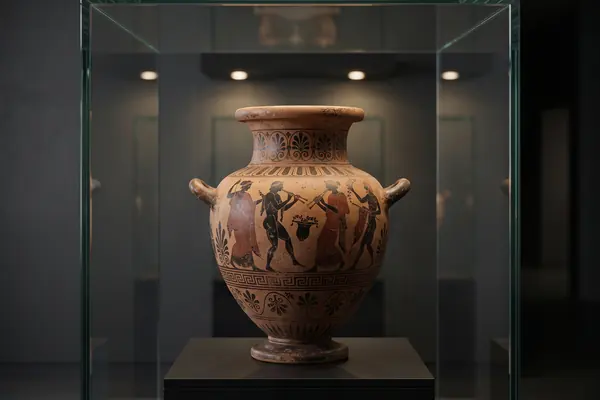
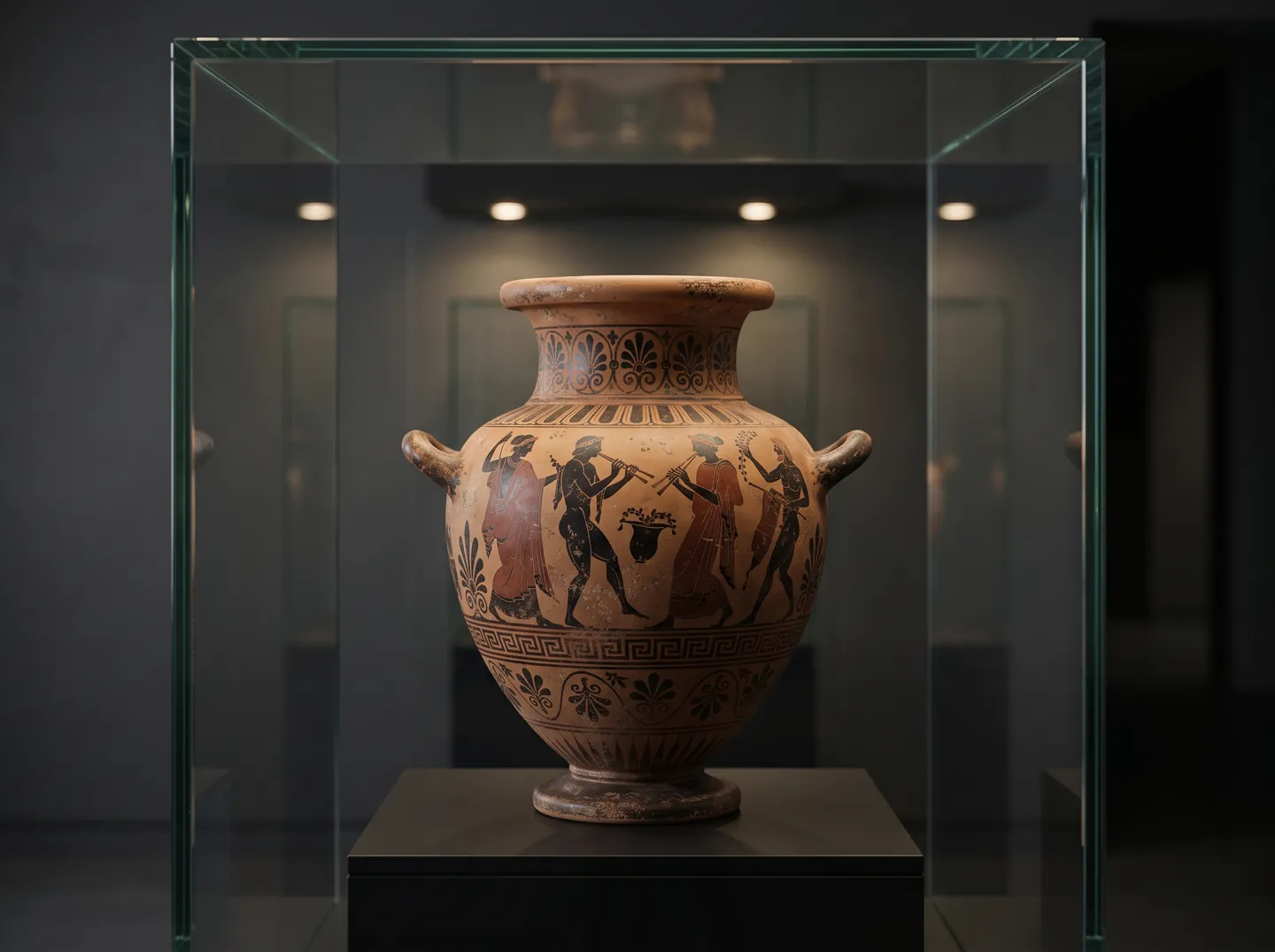
In "Ode on a Grecian Urn" Keats wonders who the dancing, music-making figures are. No Greek vase has been found that matches his description.
Read about the urnTRY ONE
A prompt from the Academy of American Poets: describe only in the first stanza, then tell a story, speak to the artist or bring yourself in.
Start writing
A THREE-STANZA EXERCISE
This follows a writing prompt from the Academy of American Poets. A gallery, a book of paintings or a postcard all work.
Pick a picture you can look at for a while: a painting, a sculpture, a photograph or even an old snapshot.
Write down what is there and nothing else. No opinions yet, just colours, shapes, people and things.
Keep describing, tell a story about the scene, or reveal something about yourself or the artist.
On a second pass, check you have used all the senses, not only sight: sounds, textures, smells, temperature.
THE URN THAT NEVER WAS
Homer's shield holds more than any real shield could, and Keats's urn matches no vase that has been found. Ekphrasis has always been free to describe art that is imagined, or stitched together from many works.
Corn also points to poets who were painters too. William Blake printed poems such as "The Tyger" with his own pictures, and Dante Gabriel Rossetti wrote verse to go with several of his paintings, sometimes inscribed below or within the picture.
QUESTIONS PEOPLE ASK
It comes from the Greek ek, out of, and phrasis, speech or expression, and is often translated simply as description. Today it usually means a poem describing or responding to a work of visual art.
The Academy of American Poets essay calls the description of the shield of Achilles, in Book 18 of Homer's Iliad, the earliest and best-known example.
No. Alfred Corn argues that a complete verbal equivalent of a picture is probably too lofty a goal, and that a partial account with a new angle is more realistic.
Yes. Some ekphrastic poems describe art photographs or ordinary snapshots. Corn notes the risk with family snapshots: only a small part of what they mean to the poet may reach a reader through words alone.
Notes on Representative Poetry Online say no Greek vase has been found that matches his description; it is thought to draw on various works of Greek art he knew.
Poets.org's notes on ekphrasis list examples including Rilke's “Archaic Torso of Apollo”, Marianne Moore's “No Swan so Fine”, William Carlos Williams's Pictures from Brueghel, W. H. Auden's “The Shield of Achilles” and Elizabeth Bishop's “Large Bad Picture”.
Sources
ABOUT THIS NAME
artsypoet.com is part of the DoodleSale portfolio. It isn't in an auction right now, but you can ask about leasing it.